Denali Expedition - West Buttress Overview AAI’s Denali climb is designed to be the safest and most successful guided expedition program on the mountain. We accomplish this goal by a process of continuous improvement, subjecting our expedition practices to careful analysis, and supporting our guides with rigorous training, evaluation, and mentoring. Since 1980, AAI has been guiding continuously on the mountain – formerly known as Mt. McKinley – and taken hundreds of people to the summit of North America.
Our expedition program and guides are so well-respected that we were ranked #1 by the National Park Service
To get a flavor of AAI's guided Denali climb, check out the audio expedition dispatches
The Mountain
"Once again, I can't say enough about the guides ... they were fantastic! The overall experience was the highlight of my mountaineering career. Thank you so much AAI!"
– Bryan F. (Bothell, WA)
Denali offers one of the world's greatest mountaineering challenges. While it is exceeded in elevation by peaks in South America and Asia, its arctic environment, with extreme temperatures and harsh storms, and its great height above the Alaskan plain make it a severe test of personal strength, team work, and logistics. No peak in the world has greater relief: Denali rises 17,000 feet above its surrounding plain. In contrast, Kilimanjaro rises 14,000 feet over its surrounding plains and Everest, only 13,000 feet. Vertical elevation gain on Everest from the normal base camp for the South Col route is 11,000 feet; from our landing spot on the Kahiltna Glacier Denali's summit rises another 13,000 feet. As the tallest mountain on the North American continent, Denali is one of the Seven Summits
Choosing a Guide Service on Denali Determining if a guided trip on Denali is right for you and picking a guide service that will offer a safe and enjoyable expedition on the mountain can be an overwhelming process.
We have compiled some of the thoughts and feedback commonly given to climbers as we have consulted them over the years. Please take some time to read through our Choosing a Denali Guide Denali FAQ
The American Alpine Institute Approach
As in other parts of the world, AAI expeditions in Alaska are run with small groups of climbers who have carefully prepared for their objective. The Institute takes a team approach to its climbs, and expedition members are expected to take responsibility for themselves and a share of responsibility for the overall operation of the expedition. We do not accept climbers who are only minimally prepared and experienced and who need to be "hauled" up and down the mountain. Trying to push ill-prepared climbers up the peak is what keeps so many guided and unguided groups from succeeding on Denali.
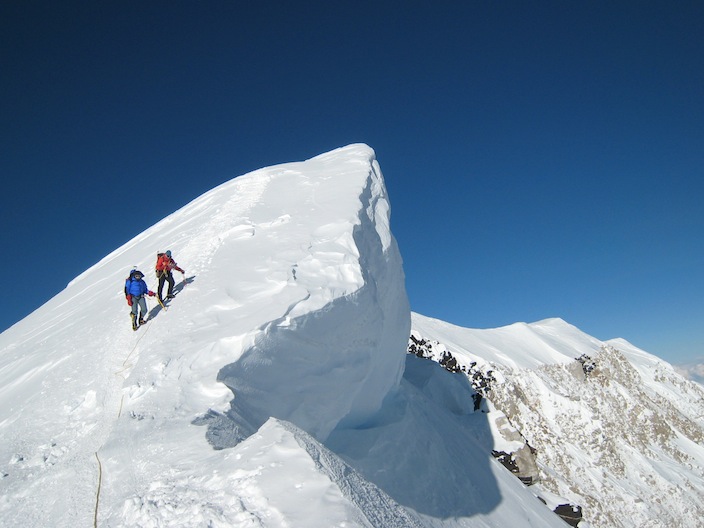
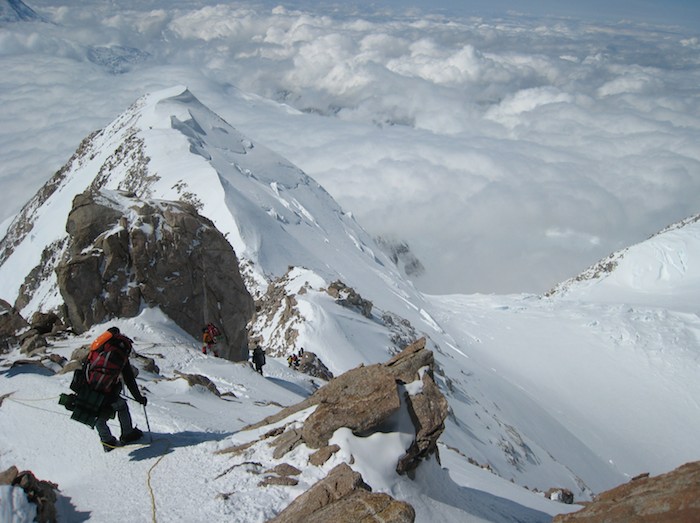
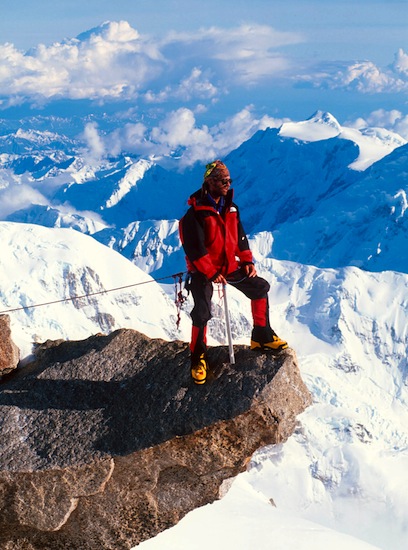
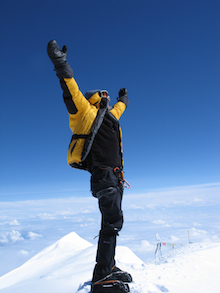
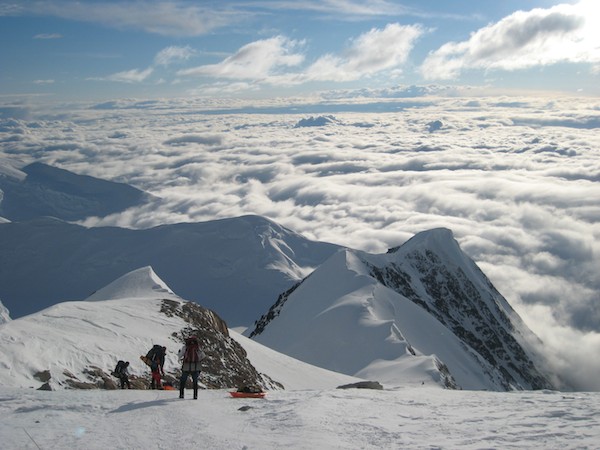
A climber stands on 'The Edge of the World', just outside Camp 3 at 14,200 ft. on Denali's West Buttress.
The Institute gives its clients careful and detailed counsel in their preparations for climbing objectives and when appropriate, has them first achieve intermediate goals to fully prepare. Climbs on Denali obviously involve many factors that we cannot control, among them temperature, wind, snowfall, and changeable climbing conditions. The key to success therefore is doing an excellent job working on those areas that a climber can do something about: skill in dealing with cold conditions, skill in climbing at an appropriate technical level, and personal conditioning. To have well-developed abilities in these areas and then to combine them with a carefully designed and guided itinerary is the most direct line to safety and success.
Preparation and Prerequisites
To succeed on Denali, you need substantial mountaineering experience and fitness. Here is a summary of the three required skill areas and AAI programs that can fulfill these requirements.
1. Glacier and Snow Climbing Skills AAI’s Denali Prep Course Alpinism 1 AMTL 1
Ice axe self-arrest and team arrest
Crampon skills on snow and ice
Basic climbing knots - figure 8, butterfly, prusik, and overhand
Fixed line travel with mechanical ascenders
2. Cold-weather and Snow Camping Experience Denali Prep Course backcountry skiing/riding winter mountaineering
3. Endurance and Altitude Experience
A long, strenuous summit day, in summer or winter – preferably exceeding 10-12 hours, such as the Mt. Baker
Experience at high altitudes – preferably at least one summit above 14,000', such as Mt. Whitney Longs Peak Ecuador’s volcanoes
Denali West Buttress Climb from John Grace on Vimeo.
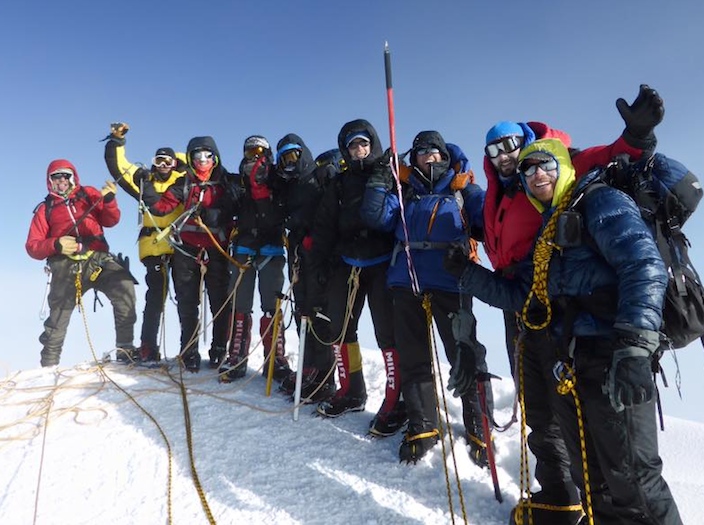
Denali Expedition - West Buttress Safety and Success An ecstatic climber at the summit of Denali. Kevin Cannon
AAI expeditions enjoy a rate of safety and success rarely matched by other teams. With well-prepared climbers, we do not have to rely on perfect conditions in order to move. Able to remain poised high on the mountain in poor conditions, our teams often make successful summit bids in small windows of good weather when other teams are out of position. AAI doesn't pretend to guarantee good health, good weather, or success on these expeditions, but we are committed to building strong teams and creating high potential for safe and successful climbs.
The overall summit success rate on Denali varies dramatically from year to year. While the average individual success rate on Denali is about 54% overall and 59% in guided groups other than AAI, in some years variations in the subarctic weather patterns cause success rates to decline. For example, the overall success rate in 2014 (as reported by Denali National Park) was a mere 35%.
The Institute's success rate for individuals for the last ten years is 63%; for expeditions, it is 72%. In the 2022 season, four of our five expeditions reached the summit.
Environmental Stewardship
AAI has the highest level of commitment to environmental protection and restoration, and on all expeditions and instructional programs we teach and follow Leave No Trace ethics and practices for travel, camping, and climbing. The Institute has been a leader in the conscientious use of wilderness environments, including both remote and popular areas of Denali and the Alaska Range.
The National Park Service presents its Denali Pro awards yearly to people who have made major contributions to protecting the mountain. Twenty AAI guides and clients have had the honor of receiving this highest Denali National Park award since its inception in 1998.
Zero Carbon Footprint Expedition
This expedition has a zero carbon footprint . Through AAI's Climate Initiative, the Institute pays to offset all carbon emissions incurred by the guides and clients on each trip, including emissions from flight, local transportation, electricity in hotels, and fuel burned to cook in the mountains. To learn more about how this works and AAI’s dedication to environmental protection, click here
Denali Prep Programs Join an expedition prep program to gain experience in cold weather climbing and camping and improve your proficiency with techniques like self-arrest, crevasse rescue, and sled-hauling.
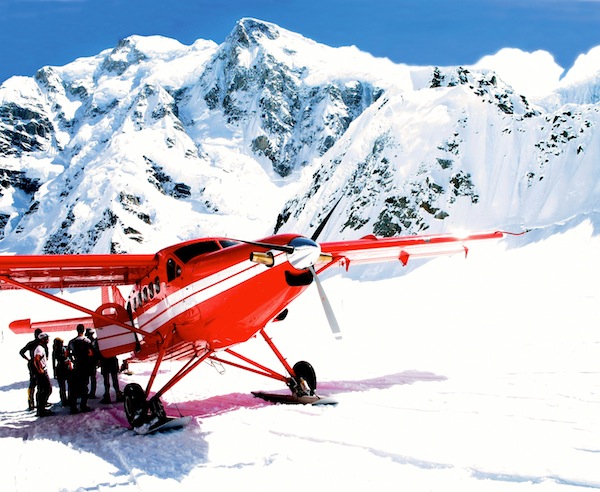
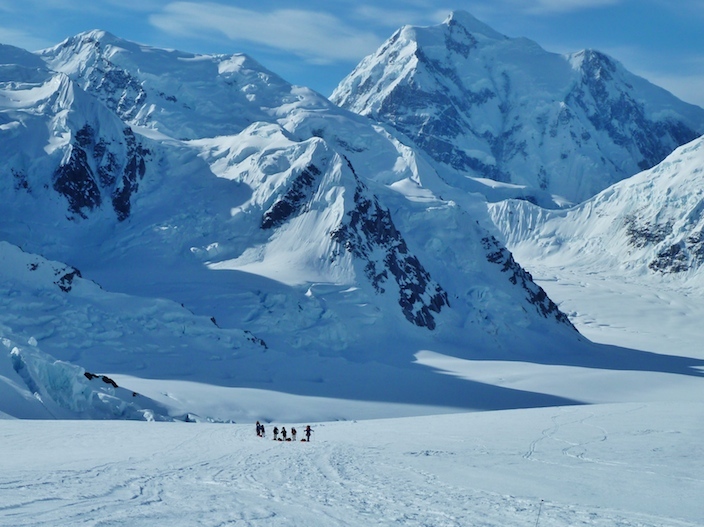
Climbers unloading gear on the Kahiltna glacier. Scott Parazynski.
Denali Expedition - West Buttress Route
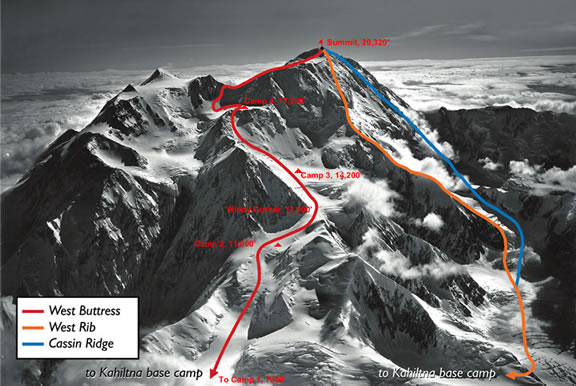
We make four camps as we climb alpine style, moving all camps higher as we go and leaving none established above or below. It is not uncommon for temperatures high on the mountain to fall as low as -30F, but at lower elevations daytime temperatures on the glacier can reach as high as 70F, so there we sometimes sleep in the day and ferry loads at night when temperatures are between 0F and 15F. The night's cold improves conditions under-foot, and we still have adequate light because of the extreme northern latitude. Double carries are done during the first part of the expedition to ease the work and to help with acclimatization.
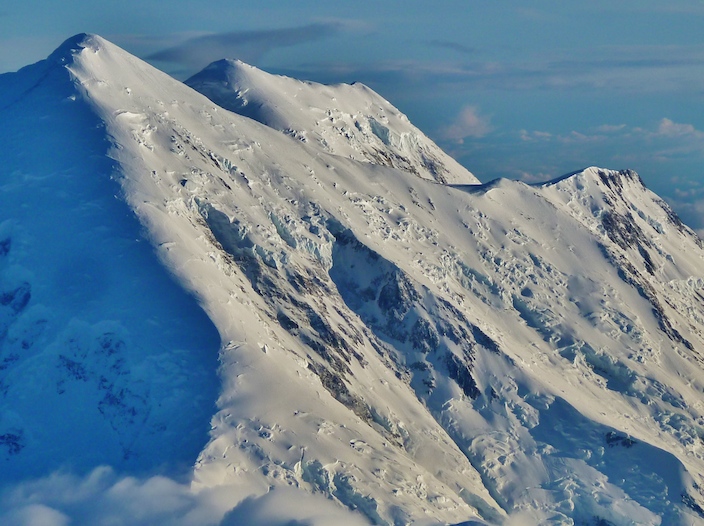
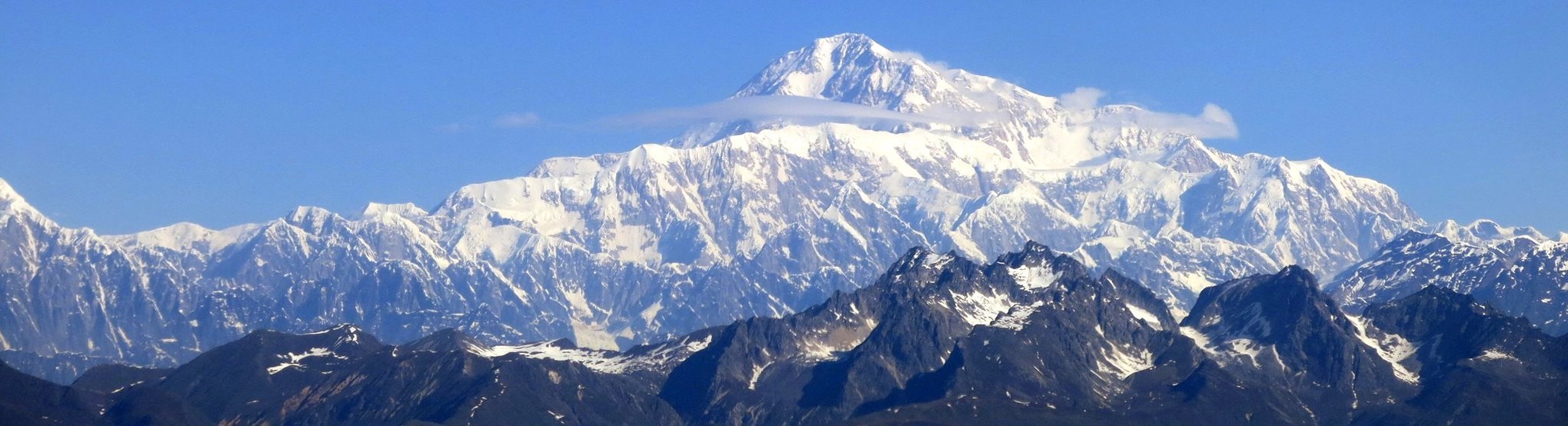
View of Denali from the South. Wyatt Evenson.
All expeditions begin with a meeting and orientation in Anchorage. We spend one night there, then travel by van the next morning to the small town of Talkeetna. There we repack our equipment, meet our ski plane pilots, and as soon as possible, make the beautiful flight to Denali Base Camp
The Kahiltna Glacier
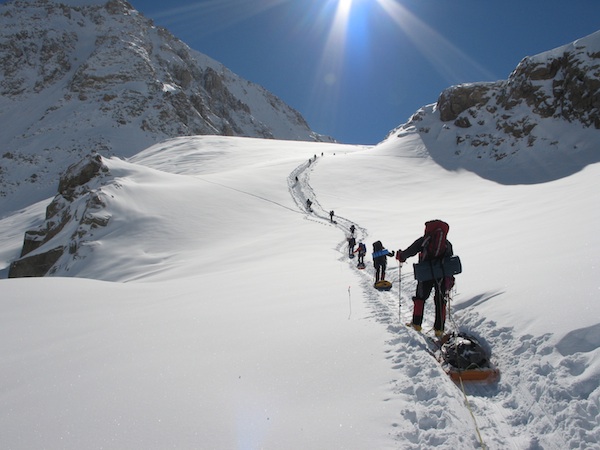
Soon after our arrival at Base Camp, having done a review of glacier travel procedures, divided the gear up, and packed our sleds, we begin moving to our first camp.
We establish our Camp 1 at 7800 West Rib Cassin Ridge Camp 2
Advancing camp on Denali with full sleds. Kevin Cannon
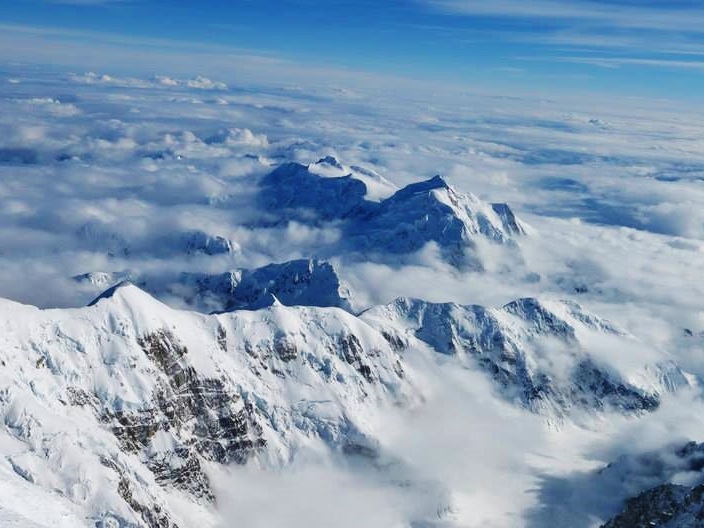
Above Camp 2, the climbing steepens as our route takes us past the terminal walls of the West Buttress. We usually cache our snowshoes at 11,200 feet and continue our climb with crampons because of the gradient of the route and the hardening snowpack. We climb out of a basin to reach Windy Corner at 13,100 feet, then make an ascending traverse through seracs and heavily crevassed terrain as we approach the head of the Kahiltna Glacier at 14,200 feet. We enjoy spectacular views as we look down to the lower Kahiltna and out to 17,004-foot Mt. Foraker. In the other direction the impressive summit bulk of Denali rises above us, and we can easily see the details of the upper West Rib and Messner Couloir, as well as the steep headwall of the West Buttress that we will soon climb.
Fourteen Camp (Camp 3)
At Camp 3 (14,200 feet)
At this point we move into the most demanding part of the expedition: higher elevations combined with steeper ground. From Camp 3, we ascend 1100 feet up a gentle snow slope to the bergschrund at the base of the West Buttress. The bergschrund is at times quite steep but it is short and, with steps established in the ice, not difficult to surmount. We then begin our ascent along fixed lines
VIDEO
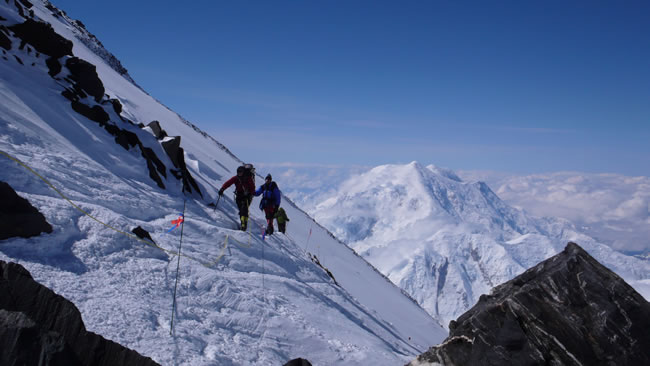
An AAI team climbing the fixed lines on the 50-degree headwall above Camp 3.
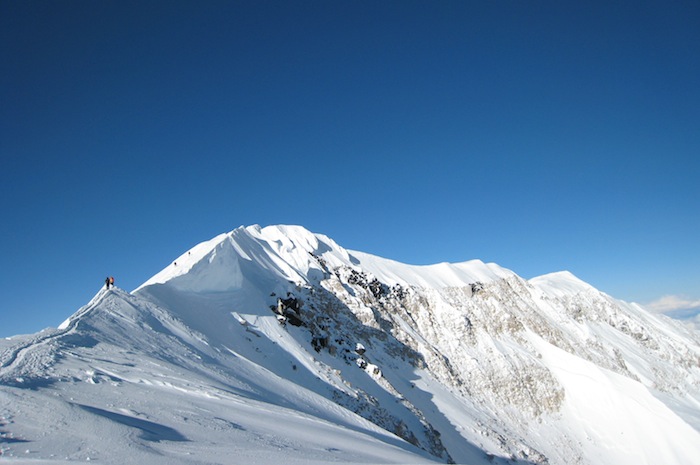
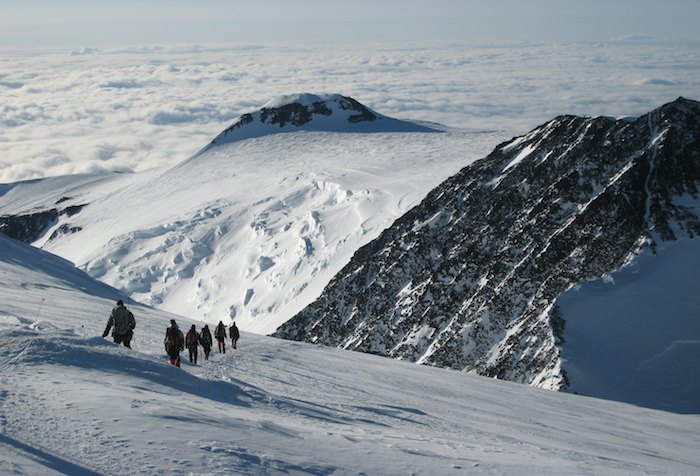
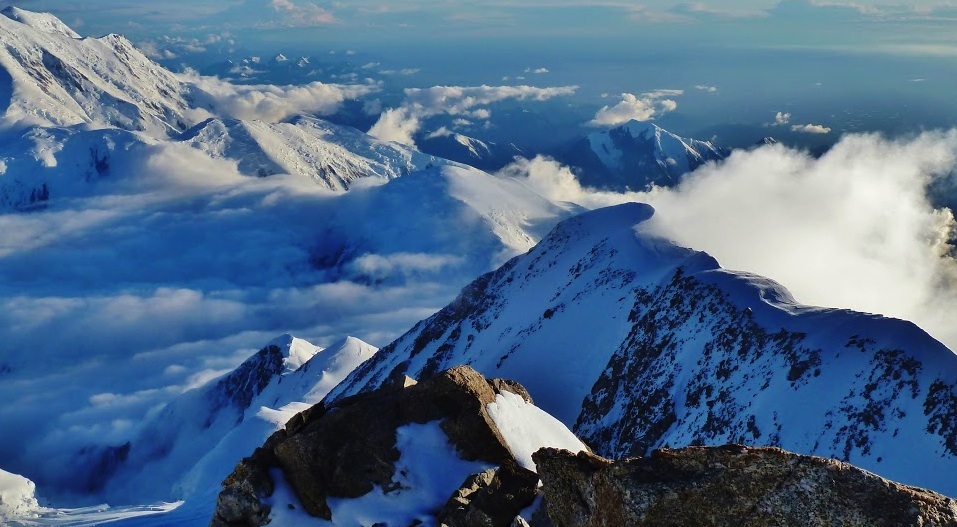
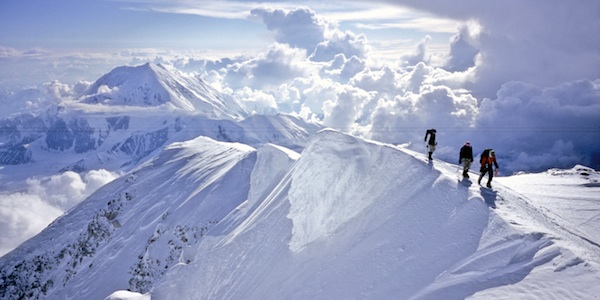
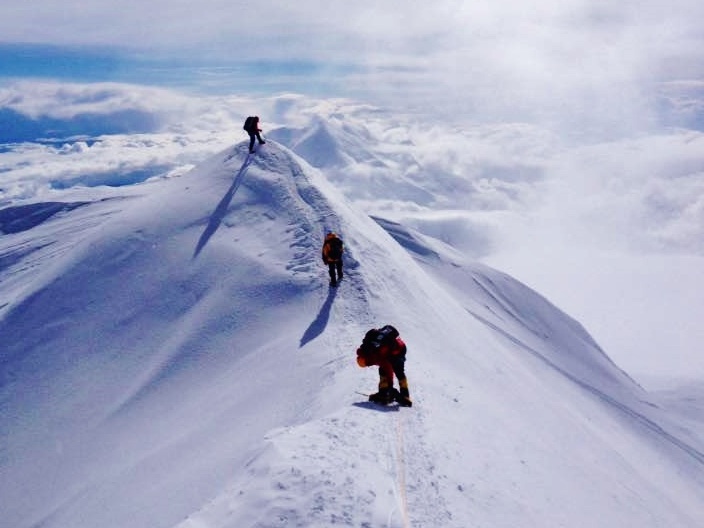
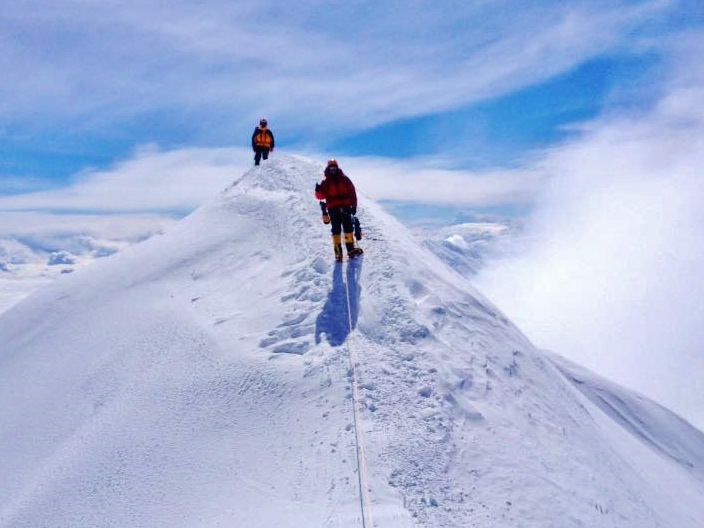
Emerging from the headwall onto the top of the Buttress, the atmosphere of the climb changes dramatically. While the earlier parts of the climb have all been on large glaciers and open slopes dominated by immense mountain masses towering above, we now move on an open ridge and enjoy that unmistakable feeling of climbing above most of the surrounding world. As we begin to move along the crest of the Buttress, we gain views across the Peters Glacier to the Alaskan tundra stretching out far beyond, and to the south we can look over the top of Mt. Hunter to the scores of other peaks in the Alaska Range. Initially the ridge is fairly broad, but as we reach the 16,400-foot level it narrows with steep drop-offs to both the north and south.
A fortified high camp at the 17,000 foot level on Denali. AAI Collection
The climb up the ridge to our final camp, Camp 4 (High Camp)
VIDEO
AAI Denali Team #2 reaching the summit. Denali is the highest mountain in North America and one of the Seven Summits. Video footage by Kevin Harker.
Summit Day
On Denali summit day
Climbers approaching the summit of Denali. AAI Collection
Denali Expedition - West Buttress Dates and Details Max Ratio - 3:1 climber to guide
Capacity - 9 climbers
Duration - 21 days
Cost - $11,995 (2024)
2024 Climbing Season
Team 1: May 6 - May 26 - 1 spots remaining!
Guides: Andy Stephen, Adam Gellman, Mike Morris
Team 2: May 13 - June 2 - 2 spots remaining!
Guides: Ian McEleney, Kevin McGarity, Tali Levin
Team 3: May 20 - June 9 - 1 spots remaining!
Guides: Tad McCrea, Justin Votos, Eli Spitulnik
Team 4: May 27 - June 16 - FULL
Guides: Quino Gonzalez, Ross Erickson, Emily Cavanaugh
Team 5: June 3 - June 23 - FULL
Guides: George Bieker, Ian Peterson, Andrew Krause
*Please inquire about the
Waitlist for expeditions that are full
Expedition Inclusions and Exclusions
Inclusions:
Professional AAI Mountain Guides' leadership, services, and instruction
NPS Entrance and User Fee
Group transportation to and from Talkeetna
Ski plane flights on and off the Kahiltna Glacier
Breakfast and dinner while in the mountains (lunch and snacks not included)
Tents and group cooking equipment
Group climbing equipment
Mechanical ascenders for fixed lines
Custom expedition sleds
Exclusions:
Lunch and snack food items, Food and lodging in town
Rescue and evacuation costs
Personal airfare
Baggage, accident, rescue, and trip cancellation insurances
Guide gratuities
Personal equipment
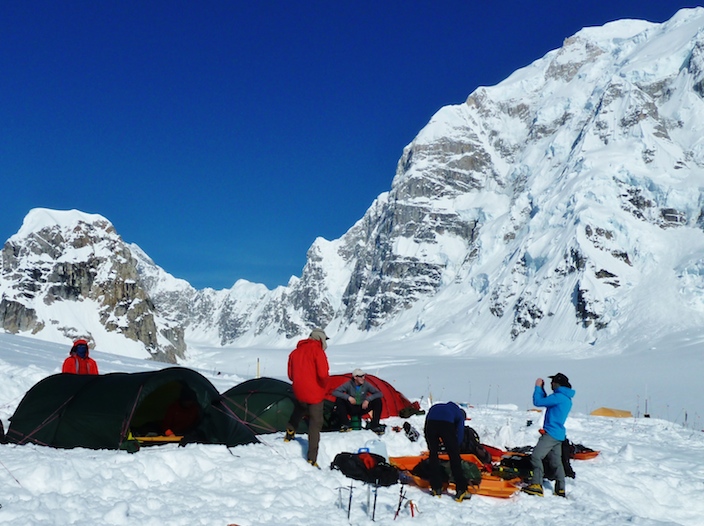
Camp 2 on Denali with views of the Direct West Buttress.
Travel Insurance
Climbing Denali is a large investment of time and resources. Unforeseen injuries, illness and scheduling conflicts can prevent you from joining an expedition at any time. We strongly suggest climbers purchase trip insurance to cover their investment. Please visit the AAI Travel Services
Private Expeditions
Climbers celebrate on the summit of Denali.
Some individuals and groups prefer private program options. Dates for all programs are dictated by the AAI concession contract with the National Park Service and private program options may be limited accordingly. Please contact the AAI office for more information.
Denali Expedition - West Buttress Promotions HOLIDAY SALE for New Registrants
Purchase a 2024 Denali Expedition, pay the full tuition by December 15th, 2023 and get a $1000 discount.
$500 off Denali Prep course tuition if you enroll both on a Denali Prep course and a Denali Expedition for 2024.
$750 off a 2024 Denali expedition & Denali Prep if you've taken an Alpinism 1 course or AMTL 1.
$500 off a Denali expedition if you've taken an AMTL 1.
$1000 off a Denali expedition if you've taken an AMTL 2.
$1500 off a Denali expedition if you've taken an AMTL 3 or 4.
__________
Denali Expedition - West Buttress Equipment A climb of Denali by any route requires specialized equipment unlike that required on mountains of comparable altitude in the temperate zones. Even experienced climbers may need to make significant equipment purchases unless they have climbed previously in the subarctic, antarctic, or Himalaya. Special-purpose items like insulated overboots and cold-weather sleeping bags can add a lot to the pricetag of a Denali trip; and the staff of major retailers often do not have sufficient expertise to provide good advice to climbers.
The AAI Equipment Shop
The mission of AAI's Equipment Shop is to outfit our climbers with the best and most appropriate gear for our climbs and expeditions. The Equipment Shop offers
Check out the online Denali equipment list at our shop website.a free, in-depth equipment consultation whose goal is to make sure that our climbers arrive in Anchorage fully equipped for success on the mountain.
Denali Expedition - West Buttress FAQs
What do you recommend as the best month to climb Denali? What type of weather can be expected? What's your success rate in reaching the summit? How do you manage the final ascent (size of final climb teams, flexibility in case someone drops out, etc.) How long has your company been organizing expeditions on Denali? What's the experience of your guides? What's the minimum level of mountain experience required for participants in the expedition? Is any type of crevasse rescue training required? How do you rig and pull expedition sleds on a glacier? How many weather days do you have planned in the expedition itinerary? How flexible is the expedition in extending this itinerary, should bad weather prevail? Can we arrange mountain insurance through you for this trip? (how much, details, etc.) What rates do you offer for private groups? Why should we choose your company? What is your safety record on Denali and elsewhere? Do you recommend any type of exercise programs to further prepare potential Denali climbers? What additional expenses are there on top of the expedition fee? Will we have to carry group gear on top of our personal equipment? How much will my pack weigh? How much of the equipment can I rent and what do you provide for gear? When should I schedule my arrival and departure flights?
1. What do you recommend as the best month to climb Denali?
In typical years we have recommended that climbers consider the late May and early June dates. This time frame usually holds the best combination of weather and conditions. However, in the last few years it has been warming up in the Alaska Range and the transition from winter to spring has been happening earlier. Over the last few years the weather and conditions have been better earlier in May than they have been in the past. As the Alaska Range and, in particular, Denali undergo the seasonal transformation from true winter conditions to more mild spring conditions, the nature of the mountain weather changes a lot. Earlier in the season (late April and early May) there are more clear days, but the wind tends to be higher on the upper mountain. Into the later season (June) the winds are less significant, but there tends to be more cloudy days and snowfall due to the warmer air. We have seen rain at base camp in April and -35 degree Fahrenheit temperatures at the end of June. Weather on Denali always keeps you guessing. We still recommend trips starting in mid to late May for folks with an open schedule as this is right in the middle of the climbing season.
2. What type of weather can be expected?
You need to be prepared for an extremely wide range of temperatures and conditions on Denali. The Kahiltna Glacier, which the West Buttress route follows, can experience some of the of the widest temperature swings on the planet. When the wind is calm and the sun is out, it can be extraordinarily hot, upwards of 80F. At the higher camps, or when a northerly system moves in, the temperatures can dip below -35F. It usually does not stay this cold for too long, but climbers can expect to see these kinds of lows for at least a few days during their climb.
Wind is perhaps the biggest danger on Denali, and climbers should be well prepared to fend off storms and protect themselves and their camps from windy conditions. Even when temperatures are mild, wind chill can accelerate the frostbite process and wreak havoc on equipment and camp sites. Winds in excess of 100mph have been recorded at 14,200 feet. On the other hand, climbers have walked to the summit in t-shirts. Be prepared for everything the mountain has to throw at you and then a little more!
3. What's your success rate in reaching the summit?
The average individual success rate on Denali is 53% overall and 59% in guided groups other than AAI. The Institute's success rate for individuals is 77%, and for expeditions it is 85%.
4. How do you manage the final ascent (size of final climb teams, flexibility in case someone drops out, etc.)
Our Denali teams consist of up to nine climbers and three guides. In the rare event that we don't have eight or nine climbers, we can run the trip at a 6:2 ratio as well, but this is not preferable and we are usually able to work other options out in the registration and pre-season scheduling process. AAI has found that due to the nature and amount of work on Denali trips, larger teams are better and more successful for a number of reasons. For one, there are more hands to help with the daily work. Also, with more guides the team has a larger variety of options should climbers need to descend or if they are in need of more personal time and attention. With more rope teams on the climb, pairing climbers of similar ability and pace is much easier.
On summit day, many complicated scenarios may arise that affect strategy. If the entire team, including the guides, are still present, the team will function the same as it has up to this point: one guide and three climbers per rope team. However, often a climber or two needs to descend and abandon their attempt on the summit. When this happens, we may have to send a guide along to accompany the climber on their return to base camp. More often than not, descending climbers are able to join another guided group that is heading back down, leaving our team intact with three guides. Groups, particularly guided groups, work together very well on the mountain and help each other out whenever possible.
5. How long has your company been organizing expeditions on Denali?
We have been guiding on Denali since 1980 and have held a concession through the National Park Service since the inception of their concession program in 1991. There are only seven guide services permitted to operate on the mountain. The National Park requires a new application process every ten years. AAI has been awarded the #1 concesson applicaton a number of times through the years.
6. What's the experience of your guides?
As a company, we are accredited through the AMGA (American Mountain Guides Association) which is the only certifying body for guides and guide services in the US. As a part of this accreditation we require that all of our instructors, upon hire, complete our Guides Training Program which is a three week, AMGA approved, professional guides' course. This course is taught by our Assistant Director Mike Powers (UIAGM/IFMGA), who is the former Technical Director for the AMGA and who still teaches AMGA certification courses. Our instructors also participate in yearly continuing education programs taught through AAI. Experience and guiding history will vary from guide to guide, as will things like avalanche training, medical certifications, and AMGA certifications. As a base, we require that guides have a WFR certification, Avalanche Level 2, and that they meet specific technical ability requirements.
Our policies for guides on Denali are as follows: On all West Buttress expeditions there will be one guide who holds the designation of "Lead Guide." This guide will have reached the summit of Denali at least once (typically several times or more) and will have been on three or more Denali expeditions previously under the leadership of another "Lead Guide." The second guide will have been on at least one Denali expedition (typically two or more) and will have guided for AAI in the US and/or South America previously. The third guide on Denali is typically on Denali for the first time but has worked as a mountian guide in the US and/or South America for at least one season previously.
7. What's the minimum level of mountain experience required for participants in the expedition?
Our requirements (prerequisites) for climbers looking to join our Denali Expedition read as follows: "Climbers need to have an intermediate level of glacier travel skills, glacier travel experience, experience with backcountry winter camping, and be in excellent cardiovascular and physical condition."
Some of these requirements are left intentionally vague because there are many different skills and experiences that could qualify someone for this trip, and/or serve as the "intermediate level" of experience that we describe. Basically, what we are looking for is that climbers are comfortable using ice axe and crampons on snow and ice up to about 45 degrees in a heavily glaciated environment. Knowing how to self arrest in the event of a fall on snow, and how to use their crampons in different positions according the angle of the slope, would be part of this.
"Glacier travel skills" indicate that you have been part of a rope team on glaciated terrain in the past and you know how to rope up and travel as a team member in a glaciated environment. Crevasse rescue (both as an individual and as part of a team is preferable) is part of the requirements here. You would at least need to be familiar with the basics of crevasse rescue and have practiced it at some point in the past. We will take some time to review this on the glacier when the Denali trip starts, but you need to come into the expedition with some knowledge of how to build a snow anchor and set up a basic hauling system. If you haven't done this in the past it should be pretty easy to get familiar with the systems either on your own or with some instruction from others.
The biggest difficulties you will face when climbing Denali are the physical and elemental challenges. The cold weather and the amount of physical work that is required to get to the top are very challenging. The climbing is mostly non-technical, but travel is on immense glaciers throughout and there are a few sections on the upper mountain where the climbing can be on very hard ice and snow up to 45 degrees in steepness. These sections are often protected by fixed ropes, but even ascending the ropes, especially with a pack and at altitude, is very strenuous.
Cold weather camping experience is crucial, and it is also usually fairly easy to attain. As you probably know, Denali can be extremely and wintery, especially on the upper mountain, and it is very important that everyone on the trip knows how to take care of themselves in these sorts of conditions. What we look for here is for folks to have spent multiple days in the backcountry, camping in winter conditions with temps close to zero or in the single digits.
VIDEO
8. Is any type of crevasse rescue training required?
Yes, definitely. See the description above in response to #7.
9. How do you rig and pull and sled on a glacier?
We have published a detailed description of our method as part of our expert tips column. You can view the full explanation, including photos, here.
10. How many weather days do you have planned in the expedition itinerary?
If we do not take any weather or rest days on the climb. It is possible to reach the summit on day 12 or 13. That having been said, most groups at a bare minimum opt for one rest day at 14,200 feet and another upon reaching High Camp. With a reasonable number of rest days and good weather, it is common for groups to summit in 17 to 18 days. Our trips are 21 days long, and these extra days are used at the discretion of the guides and the entire team for weather and/or rest along the way. It is uncommon but certainly not impossible that teams uses all 21 of their days and still do not get a window in which to attempt the summit. AAI's itinerary for the West Buttress expedition can be found under 'Course Downloads' to the right.
11. How flexible is the expedition in extending this itinerary, should bad weather prevail?
Our expedition itinerary has been designed (and modified over 25 years of operation on Denali) to offer climbers the best possible shot at the summit in a "reasonable" amount of time on the mountain and away from the real world. Based on AAI's extensive expedition experience we have found that on longer trips at altitude and in harsh environments, climbers' motivation and physical ability to summit after weeks of hard work and bad weather start fading, and in some cases vanish completely. For this reason, and also to keep the cost and length of the trip attainable for a wide range of climbers, we have designed our climbs to offer a length and summit window that is more than adequate for almost all of our expeditions. As previously mentioned, most groups only need 17 - 18 days to climb. We have had a number of trips over the years that do run out of time, but these are few and far between.
12. Can we arrange mountain insurance through you for this trip? (how much, details, etc.)
You can arrange trip and travel insurance through a company that we work with called Travelex. This insurance will cover things like your tuition, flights, baggage, and medical expenses should you get injured, sick, etc. leading up to on in the early stages of the trip. There are several different types of policies and coverage options. Read more about o ur travel insurance option here .
13. What rates do you offer for private groups?
AAI can and does schedule private expeditions throughout the Alaska Range and on Denali. The cost for these programs depends on a number of factors including the number of climbers, the length of the program or climb, and the desired climber-to-guide ratio. AAI has arranged for special "advanced itineraries" on Denali for climbers that want to combine Seven Summits ascents and take advantage of their acclimatization after coming off of peaks like Mount Everest. Please contact our office at 1-360-671-1505 for a detailed estimate of costs and special considerations surrounding a private expedition.
14. Why should we choose your company?
Choosing a guide service can be a difficult and complicated thing. AAI has published some guidelines and things to consider when Choosing A Guide Service for Denali . The best thing to do here is to make a lot of phone calls, send a lot of emails, and try to get a feel for each company, their programs, and their approach to climbing and guiding. Most major guide services on Denali have very similar trips with regard to inclusions/exclusions, cost, length, climber-to-guide ratio, and general trip logistics. There are a few differences, but none that should be the driving force behind your decision. There are, however, major differences between these companies when it comes to their philosophies and staff. It is hard to list advantages that we might offer over other companies because advantage vs. disadvantage is often times a matter of opinion. We can name a few of what we see as key differences between our company and other and other guide services. Whether or not these are good differences or bad differences depends on what you are looking for and what your personal preference happens to be.
The main difference between our West Buttress program and those offered by other guide services is the prerequisite skills and experience that we require climbers to have prior to joining our trip. Our prerequisites are a somewhat stiffer than some of the other companies, and this can mean several things. First, since we do not accept climbers who lack glacier travel or high altitude experience, we sometimes run fewer trips, or trips with fewer climbers. Second, this also means that our groups are made up of qualified people who have the skills and experience needed to be successful on the mountain. As a result, our success rate is unusually high on the mountain.
The other main difference between our climbs and others is our educational and teaching emphasis. We were founded as a mountaineering and climbingschool, and our educational/instructional programs are still at the heart of what we do. We hire guides and instructors who possess a teaching and guiding style that aligns with our mission of helping climbers to gain additional skills and grow personally on every trip, whether that be on a guided climb or on a skills and training course.
In talking about choosing a guide service, we like to tell people to speak to as many companies as possible to get a feel for the personality and core mission of each. After that, one can align with whichever company best suits their personal preference. Of course things like cost, inclusions/exclusions, strategy, group size, and so on should all come into play. From having researched these things for a few years, we can say that the differences between these items will affect your trip less than the core differences between the companies and their staff. Please reference our notes regarding choosing a guide service on Denali.
VIDEO
15. What is your safety record on Denali?
Safety is a huge concern to us, and we take the safety of the group and of each individual very seriously. Reaching the summit is secondary to returning intact and having a good experience. We are fortunate to have had an almost flawless safety record both on Denali and on our many other trips across the world. We have never had a fatality on Denali, and we take lengthy precautions to prevent such occurrences.
16. Do you recommend any type of exercise programs to further prepare potential Denali climbers?
Yes. We have a number of resources related to physical conditioning for Denali. These are included as part of the registration packet that climbers receive after having registered for an expedition.
Please contact AAI for a specific training recommendations.
17. What additional expenses are there on top of the expedition fee?
Climbers will need to arrange for their transportation to Anchorage. This is usually via a flight that will vary in cost depending on what part of the world you are coming from.
There is a fee for the shuttle we will use to get from Anchorage to the town of Talkeetna where we fly onto the glacier. This fee is not included as part of the expedition price.
For climbers arriving a day or two before the expedition starts (see the arrival and departure notes to follow) there will be a required hotel stay. Most Denali climbers share a room with a fellow climber or two to make it cheaper for everyone. Hotel rates vary based on the season. Please contact our travel coordinator
Meals prior to and after the expedition are not included.
Upon return from the glacier, climbers will have the option of heading back to Anchorage or staying the night (or even a few nights) in Talkeetna. Having dinner and drinks at one of the two local pubs in Talkeetna is a longtime tradition amongst Denali climbers and Alaska Range veterans. You will be sorely missed (and be missing out) if you opt for a swift departure. There are a number of things to do after your climb to unwind, and if you have the time to stick around we highly recommend a tour of the Park, a boat ride, or a train ride. Any lodging or transportation once you are off the mountain is not included as part of the expedition fee.
The National Park charges a climber registration fee of $275 for climbers 24 years old and younger, and $375 for climbers 25 and older. The NPS climber registration fee is included in the expedition price, but climbers still need to complete the regsitration online. We will provide a link for you to complete this.
Tips to guides are customary and are, of course, appreciated. The amount for this varies widely between climbers and this is ultimately a very personal decision.
18. Will we have to carry group gear on top of our personal equipment? How much will my pack weigh?
On top of your personal gear you will be expected to carry two group food bags (30 - 40 lbs each) and a handful of group gear such as shovels, wands, cooking gear, fuel, etc. On the lower mountain we will split our gear between our backpacks and a sled that we drag behind us. Climbers typically put about 60% of their weight in the sled and 40% in their pack on lower-angled slopes. Most climbers start out with approximately 125lbs of gear and food to manage. Much of a climber's pack weight is made up of personal clothing and equipment, and so climbers with lighter and more modern clothing and equipment will carry less weight than those with older and more bulky items.
19. How much of the equipment can I rent and what do you provide for gear?
AAI can rent you most of the camping and climbing gear you will need for this climb including a sleeping bag. We cannot rent parkas, overboots, or expedition-weight mittens. These are items that you will need to purchase or borrow. A great resource for top of the line mountaineering gear is the AAI Equipment Shop and web site . Here is a list of the items available to rent. Additionally, here is a link to our West Buttress Expedition Equipment List .
20. When should I schedule my arrival and departure flights for?
We have a mandatory orientation meeting and gear check at 2PM on the day before the expedition starts (Saturday or Day 0 on the itinerary). Most climbers plan to arrive on the evening before this day or early the morning of.
We ask climbers to plan their return flight out of Anchorage for the second full day after the expedition is scheduled to end. The reason for this is that sometimes bad weather at Base Camp can delay our flight off the glacier. It is much harder to re-book a missed flight as opposed to requesting and earlier one. Most airline companies flying out of Anchorage are more than willing to book an earlier flight when the expedition runs as scheduled, which is almost always does.
Denali Expedition - West Buttress Related Courses
Program Finder
By Location
United States - Alaska
United States - Washington
United States - California
United States - Nevada
United States - Colorado
United States - Utah
Canada - British Columbia
South America - Argentina
South America - Bolivia
South America - Ecuador
South America - Patagonia
South America - Peru
Europe - Alps and Caucasus
Asia - Nepal and Tibet
Asia - Laos, Thailand, & Vietnam
Asia - China
Asia - Japan
Africa - Tanzania
Pacific and Antarctica
By Program Type
Instructional Courses
Group Summit Climbs
Expeditions
Skills Expeditions
Private Guided Programs
Treks, Tours, & Backpacking
Corporate Outings & Services
Government & Military
By Activity
Rock Climbing
Ice Climbing
Alpine Climbing
High-Altitude Climbing
Trekking and Backpacking
Skiing & Snowboarding
Guide Training & Rescue
Avalanche Training
Departure Month
Difficulty Level
Beginner
Moderate
Intermediate
Advanced
Very Advanced
x