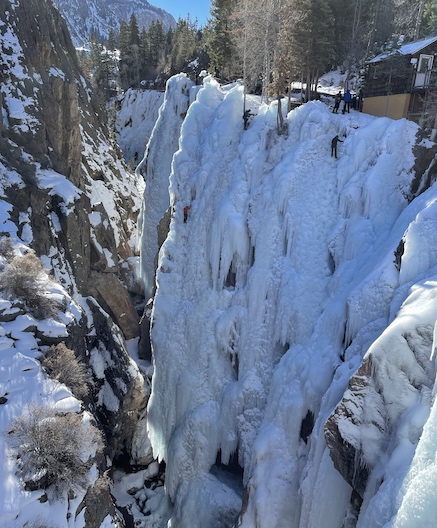
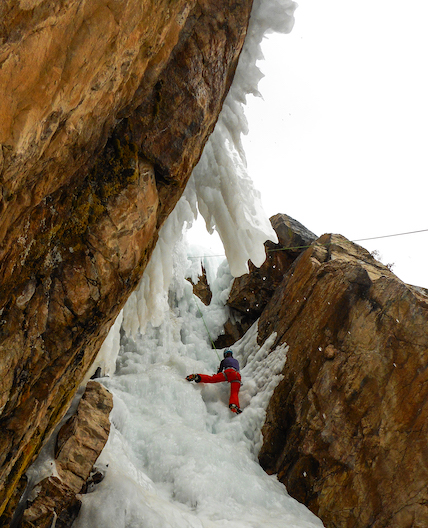
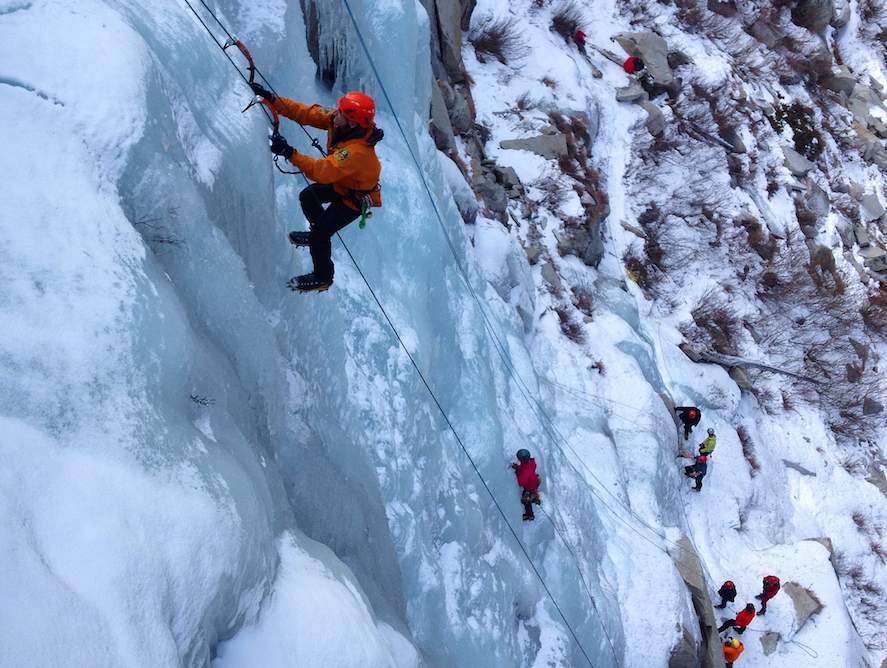
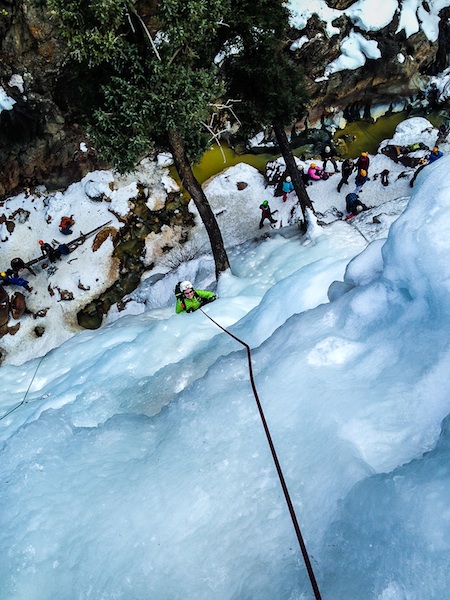
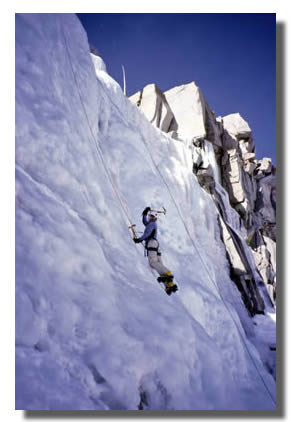
Ice Climbing - Introduction to Waterfall Ice Overview A climber ascending a steep and chandeliered curtain of ice in the Ouray Ice Park, protected by a top-rope belay. AAI Collection
Ice climbing is a vital part of any alpine climber's quiver of skills. Over the last three decades, advancements in equipment and clothing have made the sport much more accessible and enjoyable for all climbers. These advancements are allowing today’s ice climbers to pioneer routes on thin ice-smears and overhangs that were once considered unclimbable, and to push their personal limits. Ice climbing is a deeply rewarding pursuit, and nearly all who try it wind up hooked. They may even become “ice climbing junkies”...
Whether you are a budding ice climber ready to break into leading and multi-pitch climbing or an alpine climber wanting to sharpen your skills for a big ascent, we’ve got you covered. We offer our Waterfall Ice Climbing course in Ouray, CO and Lee Vining, CA. Both locations offer immaculate ice with unbeatable access, as well as nearby hotels where you can warm up, dry your gear, and maybe take a soak - Ouray in particular is renowned for its hot springs.
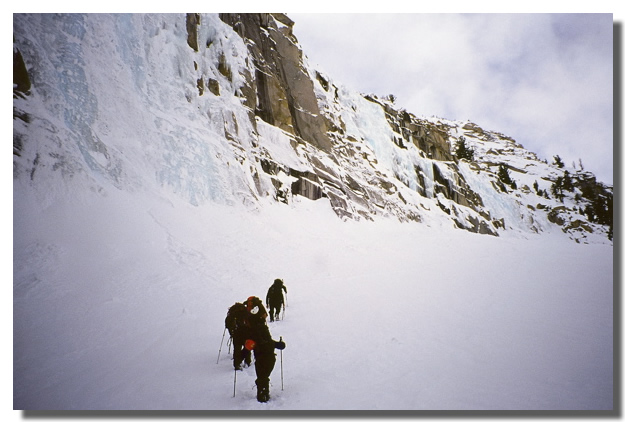
Because of its easy access, many climbers come to Ouray to train for big ascents. Although Lee Vining has a slightly longer approach, the multi-pitch lines and mixed routes are incredible and make the extra hike worthwhile. Both areas offer options for climbers of all ability levels and can help you build your skills as an ice climber.
Other Winter Courses Winter climbers should consider taking a full avalanche safety curriculum . AAI offers AIARE 1 , an Avalanche Rescue Course, AIARE 2, and an Avalanche Pro 1 and 2 Course in Washington during the winter. Please contact the office for further details on our avalanche safety courses.
AAI's Winter Comprehensive Progression
This waterfall ice climbing course can be combined with our winter mountaineering and our backcountry skiing program. When taken together or pieced together over a season or two, these programs together make up our "winter comprehensive curriculum." Here are links to the other program in this progression:
Save
Ice Climbing - Introduction to Waterfall Ice Curriculum Introductory Level Program Graduates of this course should feel comfortable in a single-pitch ice setting when climbing with a more experienced mentor.
Curriculum for this program includes, but is not limited to:
Design concept and selection of ice axes & second hand tools; reverse, classic, steeply drooped, & tubular picks; & crampons
Design concepts, selection & placement of ice screws & other ice anchors for protection and belays
Ice climbing grade system and guidebook interpretation
Ice axe & second hand tool placement techniques; third tool technique
French, German & American cramponing styles & combinations
Tool and foot progression sequence, staggered versus parallel
Top-rope system establishment and management
Ice crag hazard assessment and safety management protocols
Extensive climbing, including continuous pitch ascents
Leave No Trace climbing & travel skills
Intermediate Level Program Intermediate level students will continue to work on the skills established at the introductory level. In addition to these, climbers will develop an understanding of rappelling techniques on ice, will practice following a leader and will begin technical leadership training. All students at the intermediate level will leave with an ability to manage a single-pitch top-roping site at an ice climbing area and will have foundational ice leadership skills.
Curriculum for this program includes, but is not limited to:
Review top-rope set-ups and techniques;
Arrangement & placement of intermediate protection & belay anchors in different types of waterfall ice;
Rappelling techniques on both single and multi-pitch lines;
Mixed climbing technique and the use of leashless tools;
Mixed climbing grade system and guidebook interpretation;
Leading sequence & belay changeover;
Steep and technical climbing technique with an emphasis on pillars, chandeliers, ribbons, etc;
Multi-pitch climbing technique;
Practice leading for those qualified;
Extensive climbing, including continuous pitch ascents;
Leave No Trace climbing & travel skills.
Advanced Level Program - Available on a Private Basis Advanced level students will continue to develop their technical ice leadership skills with more lead practice, multi-pitch ice climbing, and technical rescue skills. Upon graduation, advanced level students will have the ability to lead ice and will have a solid understanding of multi-pitch technique.
Curriculum for this program includes, but is not limited to:
Review top-rope set-ups, multi-pitch sequences, and rappelling
Develop the skills to employ Leave No Trace rappel techniques
Continue to work on techniques for "high-end" climbing on steep technical ice and on mixed terrain
Continue to develop a hazard assessment matrix with an emphasis on technical and group leadership
Develop a basic understanding of high angle rescue on ice
Leading sequence & belay changeover
Leading for those qualified
Extensive climbing, including continuous pitch ascents
Leave No Trace climbing & travel skills
Ice Climbing - Introduction to Waterfall Ice Locations Two elements are required to create good ice conditions. First, there must be a consistent flow of water and second, there must be reliably cold conditions. Both Lee Vining and Ouray satisfy these requirements and consequently have amazing ice climbing opportunities.
Lee Vining and June Lake - Sierra Nevada, California
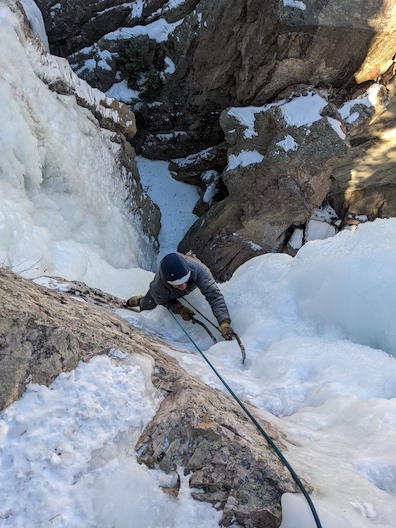
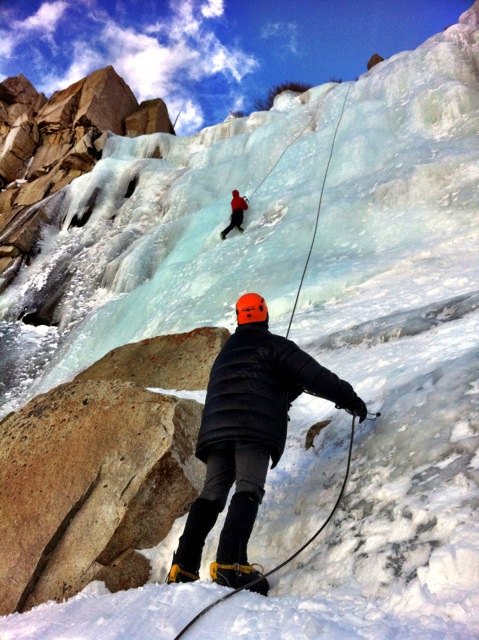
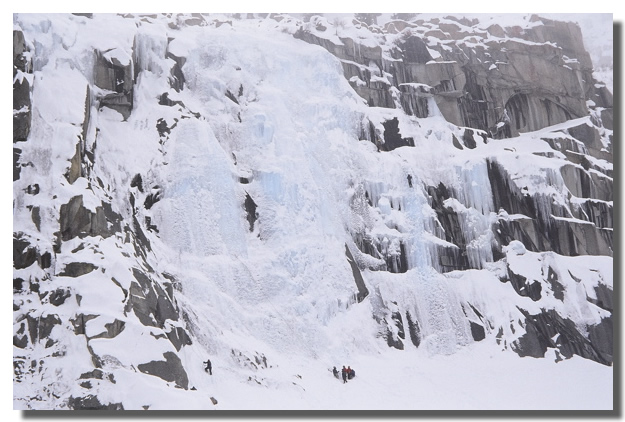
Climbing perfect ice in Lee Vining Canyon. Seth Hobby
The climate in the Sierra Nevada mountains meets each of the above prerequisites. The cold, clear nights typical of the high desert, together with moderating daytime temperatures, allow the ice to set up firm and then gradually soften during the day. The resulting ice flows provide some of the best waterfall ice climbing in the Western United States, with perfect training routes for all skill levels.
The Lee Vining ice climbing area, including the legendary Chouinard Falls, is in a deep box canyon below 13,057 ft Mt. Dana. With walls up to 2,000 vertical feet high on either side, the shadowed reaches of the canyon stay consistently cold overnight and yield ice that is almost always in excellent condition. June Lake , a few miles further south, also provides a variety of climbs at a more moderate angle with a shorter approach. This is a great area for beginners to cut their teeth and for more advanced students to study the art of leading and develop skills for mixed climbing. When the two locations are combined in a single program, their diversity and quality create one of the finest naturally occurring winter ice playgrounds in America.
Ouray - San Juan Mountains, Colorado
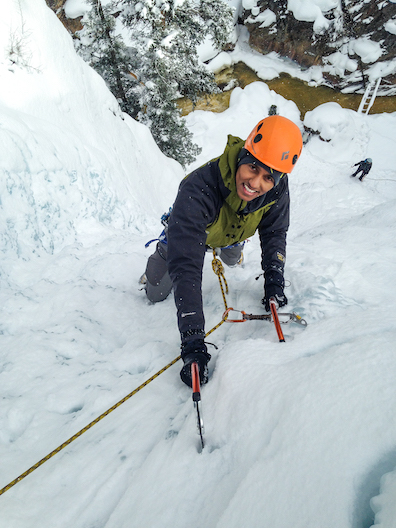
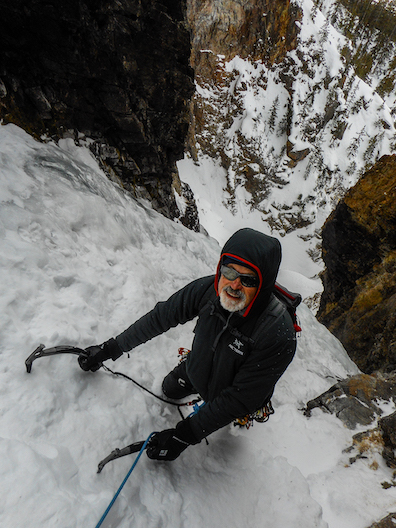
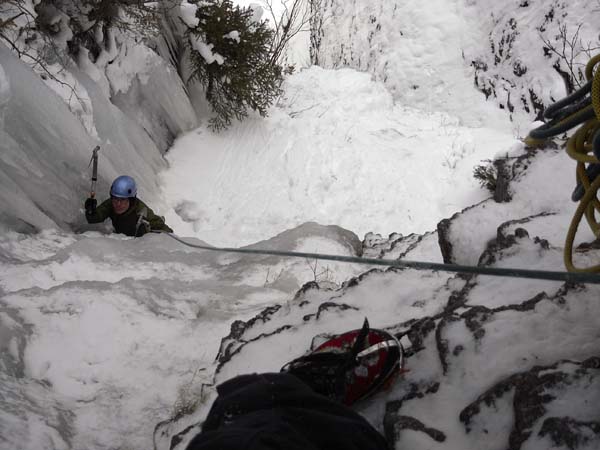
Ice is a constantly changing and always interesting medium. A climber negotiates a very featured section of climbing. AAI Collection
Ouray, Colorado is a mecca for virtually all winter sports. This tiny one-time mining town nestled at the foot of Red Mountain Pass in the San Juan mountain range, provides climbers and skiers access to some of the best routes and terrain in the Rockies. The backcountry skiing in this area is top-notch, and Ouray is home to America's first ice climbing park.
The greatest draw to the town of Ouray in the winter is the Ice Park and the annual Ouray Ice Festival, which brings in climbers from all over the world. The Ice Park is home to literally hundreds of routes from easy beginner climbs to advanced level test-pieces. Most ice climbing locations don't have a lot of variety, and climbers are often stuck with a handful of climbs at a given difficulty. However, this is not the case with Ouray. There is an enormous variety of climbs in Ouray to keep any climber entertained for months. The best way for any ice climber to improve is to get mileage, and there is no better place than the Ouray Ice Park.
While most of the climbs in the ice park are single-pitch endeavors, the backcountry area, just a short distance from the town, offers dozens of multi-pitch ice climbs just waiting to be explored.
Rocky Mountain National Park - Front Range, Colorado
Rocky Mountain National Park encompasses hundreds of winter and alpine climbs. The high elevation and cold temperatures of the area bring about winter conditions much earlier than other destinations in the US and cause them to linger far into May, providing endless opportunities to hone one’s winter mountaincraft. The ice climbing and winter ascents in Rocky Mountain National Park are only offered on a private basis. See Ice Climbing & Winter Mountaineering in Rocky Mountain National Park for more details.
Ice Climbing - Introduction to Waterfall Ice Cost and Details Public Course Rates
Lee Vining, CA & Ouray, CO:
2-day Intro to Ice Climbing: $650/person, 2 person min.
5-day Intermediate Ice Climbing: $1495/person, 2 person min.
Rocky Mountain National Park, Colorado
RMNP Ice Courses are only offered on a private basis. Please contact the AAI office for further details: 360-671-1505 or email [email protected] .
Washington
Washington Waterfall Ice Courses are only offered on a private basis. Please contact the AAI office for further details: 360-671-1505 or email [email protected] .
Private Rates These courses can also be run on a private basis. See the pages for our Private Guided Ice Climbing via the links below:
Available for any skill level at Ouray, CO , Lee Vining, CA , RMNP, CO , and in Washington state .
Ice Climbing - Introduction to Waterfall Ice Dates The American Alpine Institute offers the 2-day Introduction and 5-day Intermediate Ice Climbing course in the San Juan Mountains and the Sierra every winter. Please see public course dates below.
Outside of our scheduled dates, private courses and climbing days may be arranged as well. Please contact the AAI office for further details.
Ouray, CO
*Dates are dependent on the opening of the Ouray Ice Park & conditions.
2023-2024 Dates
2-Day Intro Group Courses
Available as private courses, contact AAI office for more details.
5-Day Intermediate Group Courses
Available as private courses, contact AAI office for more details.
Lee Vining, CA
Course dates are dependent on sufficient ice formation in Lee Vining and June Lake. Usually possible mid-December.
2023-2024 Dates
2 Day Intro Courses
Available as private courses, contact AAI office for more details.
Intermediate Courses
Available as a private courses. Call for available dates.
Rocky Mountain National Park, CO
Ice Climbing - Introduction to Waterfall Ice Related Courses
Program Finder
By Location
United States - Alaska
United States - Washington
United States - California
United States - Nevada
United States - Colorado
United States - Utah
Canada - British Columbia
South America - Argentina
South America - Bolivia
South America - Ecuador
South America - Patagonia
South America - Peru
Europe - Alps and Caucasus
Asia - Nepal and Tibet
Asia - Laos, Thailand, & Vietnam
Asia - China
Asia - Japan
Africa - Tanzania
Pacific and Antarctica
By Program Type
Instructional Courses
Group Summit Climbs
Expeditions
Skills Expeditions
Private Guided Programs
Treks, Tours, & Backpacking
Corporate Outings & Services
Government & Military
By Activity
Rock Climbing
Ice Climbing
Alpine Climbing
High-Altitude Climbing
Trekking and Backpacking
Skiing & Snowboarding
Guide Training & Rescue
Avalanche Training
Departure Month
Difficulty Level
Beginner
Moderate
Intermediate
Advanced
Very Advanced
x